Research
EU retinol limits 2025–2027: what changes on your shelf
Short answer
Regulation (EU) 2024/996 caps retinol, retinyl acetate and retinyl palmitate at 0.3% retinol equivalent in face and other products and 0.05% in body lotion, with a Vitamin A warning.1 Non-compliant stock could not be placed on the market from 1 November 2025 and must leave retail shelves by 1 May 2027.1 Plant bio-retinol, such as the Bidens Pilosa Extract in Endless Pure's Bio-Retinol line, is outside the rule.
Key facts
- Annex III entry 376: 0.3% retinol equivalent (RE) in leave-on and rinse-off products other than body lotion; 0.05% RE in body lotion.1
- From 1 November 2025, non-complying products may not be placed on the EU market; from 1 May 2027 they may not be made available, which includes retail sale.1
- Any product containing retinol, retinyl acetate or retinyl palmitate must carry: 'Contains Vitamin A. Consider your daily intake before use', whatever the concentration.1
- The caps follow the SCCS opinion adopted in October 2022, which judged 0.05% RE in body lotion and 0.3% RE in other products safe, and noted that the most exposed 5% of consumers may already exceed the upper limit from food and supplements alone.2
- Endless Pure's Bio-Retinol line is built on Bidens Pilosa Extract, a plant extract that is not vitamin A, so entry 376 and its warning do not apply to it.
What exactly does Regulation (EU) 2024/996 limit?
Three vitamin A substances: retinol, retinyl acetate and retinyl palmitate. The regulation added them to Annex III of the Cosmetics Regulation as entry 376, with two concentration caps and a fixed warning sentence.1
| Item | Rule |
|---|---|
| Substances covered | Retinol, retinyl acetate, retinyl palmitate |
| Cap in body lotion | 0.05% retinol equivalent (RE)1 |
| Cap in all other leave-on and rinse-off products (face serums, creams, eye creams, cleansers) | 0.3% RE1 |
| Warning on pack | "Contains Vitamin A. Consider your daily intake before use", for any concentration1 |
| Placing on the market of non-compliant products | Prohibited from 1 November 20251 |
| Making available (including retail sale) of non-compliant products | Prohibited from 1 May 20271 |
All rows: Regulation (EU) 2024/996.1
The reason is cumulative exposure. The Scientific Committee on Consumer Safety found vitamin A safe in cosmetics at these levels but noted that consumers with the highest intake from food and supplements could exceed safe levels once cosmetics are added.1 The SCCS put a number on it: the most exposed 5% of the population may already exceed the upper limit from food and supplements alone.2 That is why the warning talks about "daily intake" rather than skin tolerance.
Other retinoids sold in skincare, such as retinal (retinaldehyde), are outside entry 376. Watch for brands that switch to them and market the switch as a regulatory upgrade: the act does not cover them, so it endorses nothing about them either.
Which retinol stock on my shelf has to change, and by when?
Any unit above the cap, or without the warning, must be sold through or removed by 30 April 2027. The two dates refer to two moments in a product's life: "placing on the market" is the first supply on the EU market, "making available" is every supply after that, including your sale to a customer.3
| Your stock | Status today (October 2026) | What to do |
|---|---|---|
| Retinol at or below 0.3% RE, warning printed | Compliant1 | Nothing |
| Retinol at or below 0.3% RE, no warning | Non-compliant on labelling1 | Same deadlines: sell through by 30 April 2027 and reorder only relabelled packs |
| Retinol above 0.3% RE | Sellable until 30 April 2027, provided the unit was placed on the market before 1 November 20251 | Stop reordering, mark down early, plan the replacement; for units received after November 2025, get the placing date confirmed in writing |
| Body lotion with retinol above 0.05% RE | Same logic as above1 | Same actions |
| Plant "retinol alternatives" (Bidens pilosa, bakuchiol) | Not covered by entry 376 | Nothing under this act |
How do I audit retinol stock in 30 minutes?
Pull every SKU with a vitamin A name on the INCI and fill one line each. Here is a worked audit for a fictional pharmacy.
Hypothetical pharmacy, four retinol SKUs, audit done in October 2026.
| SKU | INCI name | Strength stated | Warning on pack | Units in stock | Decision |
|---|---|---|---|---|---|
| Night serum A | Retinol | 1% | No | 9 | Sell through by April 2027; markdown from January; no reorder |
| Night cream B | Retinol | 0.3% | Yes | 14 | Keep |
| Eye cream C | Retinyl Palmitate | "0.5% retinyl palmitate" | Yes | 6 | Ask brand for the RE value; keep if confirmed at or below 0.3% RE |
| Body lotion D | Retinol | 0.1% | No | 5 | Above the 0.05% body cap: sell through by April 2027, no reorder |
Result: two SKUs to run down, one to confirm in writing, one to keep. Two facings free up by spring 2027.
The step that catches buyers out is eye cream C. Retinyl palmitate is a heavier molecule than retinol, so a percentage of the ester is not the same number in retinol equivalent. Ask the brand for the RE figure in writing and file it with your supplier documents.
Where does bio-retinol sit under the new rules?
Outside them. "Bio-retinol" is a trade name for plant extracts, most often Bidens Pilosa Extract, that are marketed as retinol alternatives. They are not vitamin A, so they carry no 0.3% cap, no warning sentence and no 2027 deadline.1 The INCI tells you which you are holding: if the list shows retinol, retinyl acetate or retinyl palmitate, entry 376 applies; if it shows Bidens Pilosa Extract or Bakuchiol, it does not.
Know the evidence before you brief staff. Bakuchiol has one small 12-week randomised trial against retinol;4 the best-known Bidens pilosa work is a laboratory study on fibroblasts and skin fragments.5 Both are reasons the ingredients are used, not proof that a given cream matches retinol.
Being outside the act is not a claim in itself. A shelf card saying "compliant with the new EU retinol rules" is weak wording; describe what the product is instead. For a full comparison of retinol, Bidens pilosa bio-retinol and bakuchiol, including how each is positioned to shoppers, see the retinol to bio-retinol shift.
What should I put in the freed retinol facings?
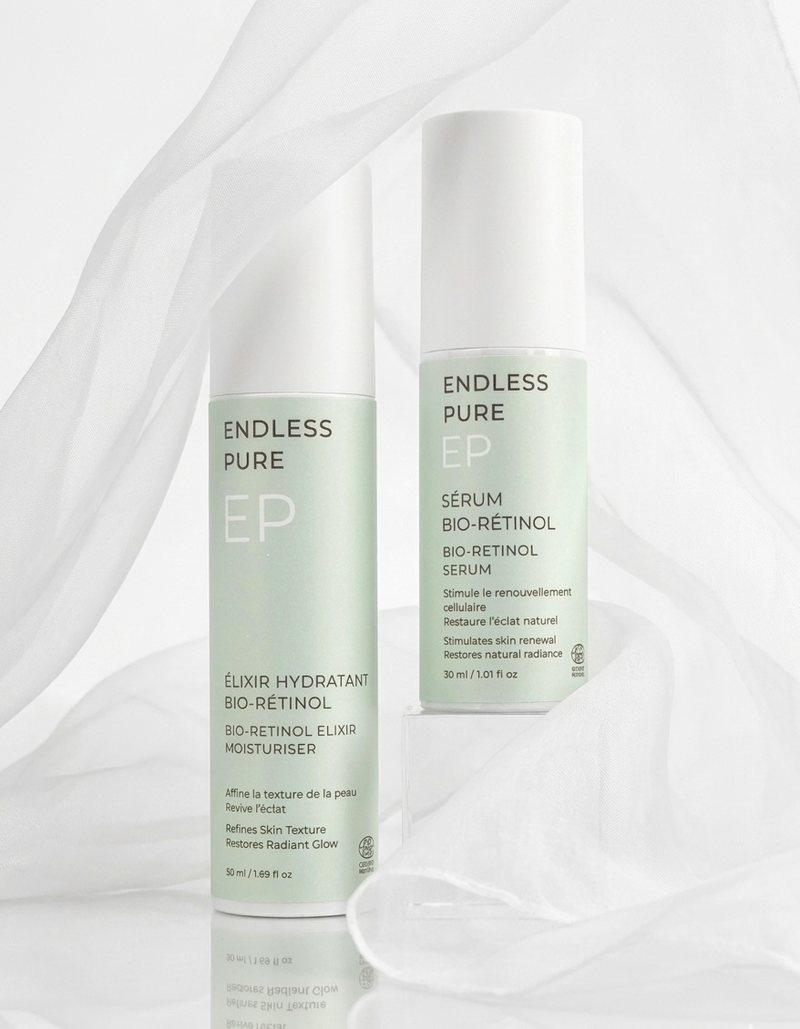
A plant bio-retinol routine that a pharmacist or beauty adviser can recommend without the vitamin A conversation. The Endless Pure Bio-Retinol line, mapped against the rest of the range in the SKU matrix, fits that slot: Bio-Retinol Serum (Bidens Pilosa Extract with lactic acid, rosehip oil and hyaluronic acid) and Bio-Retinol Elixir Moisturiser (Bidens Pilosa Extract with Alteromonas Ferment Extract, jojoba and mango butter).
When should I place the replacement order?
Order the replacement by February 2027, so it is on the shelf before you start the final markdown of the old retinol SKUs. Endless Pure produces each wholesale order as a fresh batch; production time depends on the order volume, and EU delivery then takes up to 10 business days from dispatch. Ordering in February leaves months before the deadline, so lead time is not the constraint. Sell-through is: you want customers to try the new routine while the old one is still available.
A simple timeline:
- November 2026: audit, stop reordering non-compliant SKUs.
- February 2027: place the replacement order; start offering the new routine to retinol buyers.
- March–April 2027: final markdown on non-compliant units.
- 1 May 2027: shelf fully compliant.
What the February order can look like:
| Product | Units |
|---|---|
| Bio-Retinol Serum | 3 |
| Bio-Retinol Elixir Moisturiser | 3 |
| Bio-Retinol DUO (serum + moisturiser) | 2 |
| Peptide Smoothing Eye Cream | 3 |
| SPF50 Stick | 3 |
| Total | 14 |
The SPF stick is there for a reason: the Bio-Retinol Serum contains lactic acid, and a morning SPF is the natural partner for any renewal routine.
For staging a new line with minimal risk, see adding a brand without stock risk; for the wider legal documents to hold, what certification skincare needs before you sell. Pharmacy buyers will find the range logic in the pharmacy wholesale guide, the pharmacy guides and all Guides.
Frequently asked questions
What is the maximum retinol allowed in a face serum in the EU?
0.3% retinol equivalent, the cap for all leave-on and rinse-off products other than body lotion; body lotion is capped at 0.05%.1
Can I still sell a 1% retinol serum I bought in 2025?
Only until 30 April 2027, and only if the unit was placed on the EU market before 1 November 2025. From 1 May 2027 no non-compliant unit may be made available, including from your shelf.1
Does the EU retinol limit apply to retinal or bakuchiol?
No. Entry 376 names only retinol, retinyl acetate and retinyl palmitate.1 Bakuchiol and Bidens pilosa extract are plant ingredients, not vitamin A.
Do low-strength retinol products also need the Vitamin A warning?
Yes. The sentence 'Contains Vitamin A. Consider your daily intake before use' is required on any product containing the three substances, regardless of concentration.1
Who is responsible if non-compliant retinol stock is sold after May 2027?
The retailer is exposed too. Making available covers every supply in the course of a commercial activity, including a shop sale,3 and from 1 May 2027 that supply of a non-compliant unit is prohibited. Clear the stock before the deadline.
Is 'retinol equivalent' the same as the percentage on the box?
Not always. Retinyl esters weigh more than retinol, so a percentage of retinyl palmitate is not the same figure in retinol equivalent. Ask the brand to state the RE value in writing.
Does Endless Pure Bio-Retinol carry the EU Vitamin A warning?
No. Its active is Bidens Pilosa Extract, a plant-derived ingredient that is not one of the three vitamin A substances in entry 376, so neither the 0.3% cap nor the warning sentence applies.1
Sources
- European Union, Commission Regulation (EU) 2024/996 of 3 April 2024 amending Regulation (EC) No 1223/2009 as regards the use of Vitamin A, Alpha-Arbutin and Arbutin and certain substances with potential endocrine disrupting properties in cosmetic products (OJ L, 4.4.2024) (2024). eur-lex.europa.eu Checked 2026-10-22.
- European Commission, Scientific Committee on Consumer Safety (SCCS), Revision of the scientific Opinion (SCCS/1576/16) on Vitamin A (Retinol, Retinyl Acetate, Retinyl Palmitate), SCCS/1639/21, adopted 24-25 October 2022 (2022). health.ec.europa.eu Checked 2026-10-22.
- European Union, Regulation (EC) No 1223/2009 on cosmetic products, Article 2(1)(g) and (h) (2009). eur-lex.europa.eu Checked 2026-10-22.
- British Association of Dermatologists, Plant extract found to rival leading anti-ageing skincare ingredient (press release, 21 November 2018) on Dhaliwal S, et al. Prospective, randomized, double-blind assessment of topical bakuchiol and retinol for facial photoageing. Br J Dermatol (doi:10.1111/bjd.16918) (2018). www.skinhealthinfo.org.uk Checked 2026-10-22.
- Evidence-Based Complementary and Alternative Medicine, Dieamant G, Pereda MDCV, Nogueira C, et al. Antiageing Mechanisms of a Standardized Supercritical CO2 Preparation of Black Jack (Bidens pilosa L.) in Human Fibroblasts and Skin Fragments. 2015:280529 (doi:10.1155/2015/280529) (2015). pmc.ncbi.nlm.nih.gov Checked 2026-10-22.