Comparisons
Dermocosmetics vs certified green biotech in 2026: who wins which shelf
Short answer
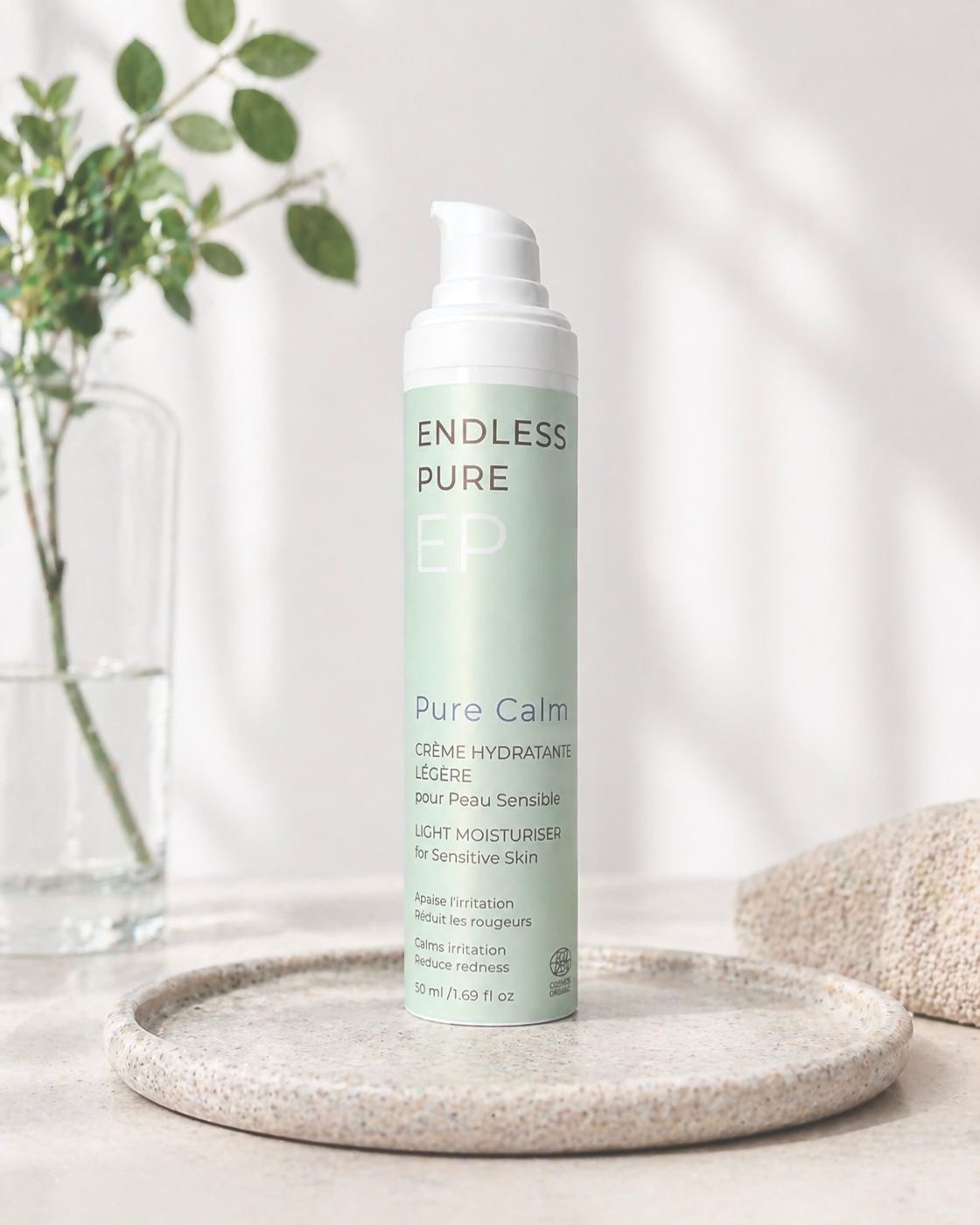
Conventional dermocosmetics win when the customer wants the pharmacist's standard, minimal-formula answer. Certified green biotech wins when she reads INCI, asks for a certificate or wants a plant alternative to retinol. Run both by splitting roles: keep your dermocosmetic cleansers and basics, and add a certified block of 4–6 SKUs, such as Endless Pure's fragrance-free PURE CALM moisturiser and night cream.
Key facts
- 'Dermocosmetic' is a market term; EU law knows only the cosmetic product, defined by its purpose (Regulation 1223/2009, Article 2(1)(a)).1
- Article 20 bars any text implying characteristics a product lacks, so neither 'gentler' nor 'safer' may be printed for organic lines without evidence.1
- COSMOS ORGANIC requires at least 95% organic agro-ingredients, verified by an audit at least once a year.23
- French pharmacy dermocosmetics were worth EUR 3,119 million in 2025, +6.2% in value.4
- French organic cosmetics reached EUR 1.1 billion in 2024, across all channels.5
- Endless Pure's PURE CALM Light Moisturiser and Night Recovery Cream are fragrance-free and dermatologically tested.
What is the real difference between dermocosmetics and certified green biotech?
One is a positioning, the other is an audited way of building a formula. Dermocosmetic is a market term for pharmacy-channel brands with a clinical tone; EU law only knows the cosmetic product, defined by its purpose.1 Certified green biotech means a formula certified under COSMOS that combines plant ingredients with biotech-derived actives such as ferments, biofermented hyaluronic acid or marine ferment extracts.
| Conventional dermocosmetic | Certified green biotech | |
|---|---|---|
| Formulation logic | Short, functional formulas; synthetic and natural ingredients mixed freely | Plant base plus biotech actives, within COSMOS ingredient rules |
| Outside audit | None required beyond the law | COSMOS audit at least once a year3 |
| What the pack proves | The brand's own claims | A named standard, level and certifier |
| Typical shelf role | Default pharmacist recommendation, basics, very reactive skin | Certified alternative, plant actives, ingredient-led customers |
| Fragrance | Often fragrance-free across the range | Varies by product; read each INCI |
| Customer question it answers | "What do you recommend?" | "Is this certified? What is in it?" |
Both sit under the same claims rule: no text implying a characteristic the product lacks (Article 20).1
Where does each win on the pharmacy shelf?
Each wins a different set of roles. Map your shelf by role and the decision becomes simple.
| Shelf role | Who usually wins | Why |
|---|---|---|
| Basic cleanser for very reactive skin | Dermocosmetic | Your team already trusts it; the customer wants the standard answer |
| Barrier creams marketed for compromised skin | Dermocosmetic | Specialist positioning built over years |
| Fragrance-free daily moisturiser, certified | Certified green biotech | Same need, plus a certificate and a plant-derived INCI |
| Retinol alternative for anti-age | Certified green biotech | Plant bio-retinol answers the customer who avoids synthetic retinoids |
| Night cream for an ingredient-led customer | Certified green biotech | She reads the INCI; a red-algae and HA formula gives her something to read |
| Mineral SPF | Either | Stock one; the certified mineral stick doubles as a till add-on |
Both segments are growing. French pharmacy dermocosmetics reached EUR 3,119 million in 2025, +6.2% in value,4 and French organic cosmetics were worth EUR 1.1 billion in 2024 across all channels.5 The two figures measure different scopes, so read them as two healthy segments, not as a share.
Which customer does each one serve?
Three profiles cover most pharmacy conversations.
- The recommendation seeker. Asks "what should I use?" and wants a quick, trusted answer. Dermocosmetic default; offer the certified line only if she mentions ingredients.
- The INCI reader. Turns the pack over, asks about certification or plant actives. Certified green biotech; a routine that makes sense gives her a reason to buy a second product. When she doubts that a certified formula can hold real actives, brief your team with which actives COSMOS allows.
- The retinol avoider. Has tried retinol and disliked it, or wants a plant option. Bio-retinol from Bidens pilosa. Bio-retinol is not a retinoid, so it is not affected by the retinol limits in Regulation (EU) 2024/996; see the bio-retinol guide.
How do you run both without cannibalisation?
Split roles, separate blocks, separate price logic. We suggest four rules.
- One role, one brand. Never stock two cleansers for the same customer from two approaches. Choose the one your team recommends.
- Side-by-side blocks. Put the certified block directly next to the dermocosmetics at the same height, with its own header card naming the certificate. Shoppers can then compare across the boundary without the two approaches being mixed.
- Bridge with SPF. A mineral SPF sits naturally at the junction of the two blocks and at the till.
- Write a stop rule before ordering. For example: fewer than six units of the hero SKU sold in eight weeks means you cut to two facings. The maths is in reordering by sell-through.
Common mistake: presenting the certified line as "gentler" or "safer". That is an implied characteristic under Article 20, and it also insults the dermocosmetic brands your team recommends every day. Present it as "certified, with plant and biotech actives".
What do you say at the counter?
Use scripts that describe roles and facts, never outcomes.
- INCI reader: "This night cream is COSMOS certified by ECOCERT and fragrance-free. The base is aloe with a red algae extract and hyaluronic acid."
- Retinol avoider: "This serum uses Bidens pilosa extract, a plant bio-retinol, with lactic acid and rosehip oil. It's for morning or evening."
- Undecided: "If you'd like the one most customers start with, it's this one. If you prefer a certified formula, this block is all COSMOS certified."
How does Endless Pure fit next to your dermocosmetics?
As the certified block, with INCI notes your team can repeat; the Endless Pure range matrix lists every SKU. PURE CALM Light Moisturiser and PURE CALM Night Recovery Cream are fragrance-free and dermatologically tested, so they suit a customer avoiding fragrance, next to the dermocosmetic products your team already recommends. That pairing is exactly how the two approaches coexist. The Bio-Retinol Serum and Elixir serve the anti-age customer.
Every product in this block is ECOCERT COSMOS certified, Natural or Organic (the Eye Renewal Patches, outside it, are not), and all are made in ISO 22716 certified GMP facilities. Each order is produced as a fresh batch, with production time depending on the order volume, and there is no per-SKU minimum, so you can reorder small quantities as the block proves itself.
| Product | Units |
|---|---|
| Bio-Retinol Serum | 3 |
| Bio-Retinol Elixir Moisturiser | 3 |
| PURE CALM Light Moisturiser | 3 |
| PURE CALM Night Recovery Cream | 2 |
| SPF50 mineral stick | 3 |
| Total | 14 |
The pharmacy terms are on the pharmacy wholesale page, the block layout in the certified shelf guide, and all pharmacy guides in the pharmacy section.
Frequently asked questions
What is the difference between dermocosmetics and organic skincare?
Dermocosmetic describes a positioning: pharmacy-channel brands with a clinical tone and usually minimal formulas. Certified organic or natural describes how a formula is built and audited under a public standard such as COSMOS. A product can be one, both or neither.
Will a certified organic line cannibalise my dermocosmetic brands?
Only if it repeats the same roles. Keep the dermocosmetic cleansers, basics and very reactive-skin products, and give the certified line the roles they leave open, such as a plant retinol alternative or a certified night cream.
Is organic skincare gentler than dermocosmetics?
Not as a rule, and you may not imply it. A certificate describes how a product is made and audited, not how it behaves on a given skin, and Article 20 of the Cosmetics Regulation bans implied characteristics.1
Which pharmacy customer buys certified green biotech skincare?
The one who turns the pack over. She reads the INCI, asks whether a product is certified, avoids synthetic retinol or wants plant-derived actives with real formulation behind them.
How many certified SKUs should a pharmacy start with?
Four to six, one per open role, placed as a block next to the dermocosmetics. We suggest reviewing sell-through after eight to twelve weeks before adding depth.
Can a pharmacy recommend a certified line to a customer with very reactive skin?
Only products whose INCI fits her. Check fragrance first: a fragrance-free moisturiser can sit in that recommendation, a product whose INCI includes Parfum or essential-oil allergens should not.
Sources
- European Union, Regulation (EC) No 1223/2009 on cosmetic products, Articles 2 and 20 (2009). eur-lex.europa.eu Checked 2026-10-22.
- COSMOS-standard AISBL, COSMOS-standard, Cosmetics Organic and Natural Standard, version 4.2 (2025). media.cosmos-standard.org Checked 2026-10-22.
- COSMOS-standard AISBL, COSMOS-standard Control Manual: accreditation and certification requirements, version 4.2 (2025). media.cosmos-standard.org Checked 2026-10-22.
- IQVIA Consumer Health France, Flash Marche Consumer Health (January 2026 issue; dermocosmetics classes 80 to 94, year to December 2025) (2026). pharmastat.iqvia.com Checked 2026-10-22.
- Cosmebio (French organic cosmetics trade body), Dossier de presse 2025 (2024 organic cosmetics turnover in France) (2025). media.cosmebio.org Checked 2026-10-22.